Water Filtration & Reverse Osmosis in Wilmington, NC
Is your Wilmington water safe?
Cape Fear River water still reaches the tap with chlorination byproducts far above EWG's health guidelines, and trace PFAS remain even after CFPUA's plant upgrades. Homes on private wells near the Chemours plume get no municipal treatment at all. We'll test your water free and show you your own numbers.
Get Your Free Quote
No credit card. No obligation. We'll reach out within 1 business day.
What's Actually In Wilmington's Tap Water?
CFPUA has made real progress on PFAS at the Sweeney plant. Here's what its 2025 report shows — and what still comes out of your tap.
Reduced at the treatment plant
GenX (HFPO-DA)
The compound that made Wilmington national news. After CFPUA’s granular activated carbon retrofit at Sweeney, the annual average is a fraction of a part per trillion.
average, 2025
0.10 ppt
PFOA
Against an EPA maximum contaminant level of 4.0 ppt. CFPUA finished water is roughly two orders of magnitude below the federal limit.
average, 2025
0.03 ppt
Lead
Below the detection threshold at the 90th percentile. Lead in Wilmington is a private-plumbing question, not a utility one — CFPUA is still inventorying service lines.
90th percentile
<3 ppb
Trace PFAS still reach the tap, and plant carbon only works as long as it is replaced on schedule. Reverse osmosis at your kitchen sink removes 95–99% of PFAS as a final barrier you control.
Source: CFPUA 2025 Drinking Water Quality Report, CFPUA-Wilmington system (PWS ID# 04-65-010). All values are CFPUA's own published results. TTHM and HAA5 figures are the highest locational running annual average; the range spans all sampling sites. CFPUA water meets every federal standard.
What's Still In Wilmington's Tap Water?
Both chlorination byproducts are within federal limits, and both are hundreds of times over EWG's health guidelines. Hover or tap one to see where it hits the body.
Wilmington Tap Water
Cape Fear River
Chlorination byproducts linked to cancer and developmental harm. Ranged up to 25.7 ppb across the system against a 60 ppb federal limit.
Formed when chlorine reacts with organic matter from the Cape Fear River; linked to bladder cancer and pregnancy complications. Ranged up to 48.6 ppb against an 80 ppb federal limit.
Tap a row to see what it affects Hover a contaminant to see what it affects
- 100× or more over guideline
- 20–100× over
- Under 20× over
- Not linked in this city
Common Wilmington Water Problems
And the systems we use to solve them.
Chlorine Byproducts
The Sweeney plant disinfects Cape Fear River water with chlorine, and the byproducts are what the 2025 report actually flags — trihalomethanes running to 48.6 ppb at the high end of the distribution system.
Our solution
Whole-home carbon filtration removes chlorine and its byproducts at every tap, with reverse osmosis as a second barrier at the kitchen sink.
Private Wells Near the Plume
CFPUA’s carbon filters protect CFPUA customers. Homes on private wells in New Hanover, Pender and Brunswick counties get none of that treatment, and the Chemours groundwater plume is a live problem for some of them.
Our solution
Wells need testing before anything is specified. Reverse osmosis is the proven technology for PFAS, but the test comes first — always.
Wrightsville Beach Runs Different
The Wrightsville Beach system is groundwater, not river water, and it behaves nothing like the main system — hardness ranging to 330 ppm and sodium to 166 ppm in CFPUA’s 2025 sampling.
Our solution
Hard, salty groundwater like this is exactly what a water softener is built for, paired with carbon filtration. We confirm which system serves your address during the free water test.
The Right System for Your Water
Whether you have chlorine-tasting city water, hard or smelly well water, or just want better tasting drinking water—we have the perfect solution.

Complete Home System
The ultimate whole-house solution. Whole-home filtration and softening in one system — protects every tap, every appliance, every shower.
- Whole-home filtration
- Water softening included
- Removes chlorine & chloramines
- Reduces heavy metals
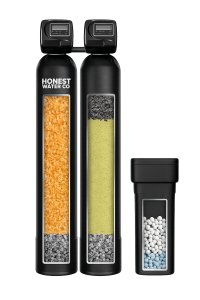
Well Water System
Complete multi-stage treatment for well water. Removes iron, sulfur, sediment, hardness, and bacteria — everything well water throws at your home.
- Removes iron up to 15 ppm
- Eliminates sulfur smell
- UV sterilization included
- Sediment pre-filtration
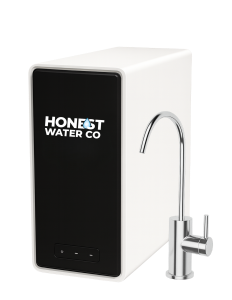
7-Stage Reverse Osmosis
Premium tankless RO with alkaline filtration. 800 GPD of purified, pH-balanced drinking water on demand — no storage tank needed.
- 800 GPD tankless design
- 7-stage filtration
- Alkaline pH balancing
- Color match faucet included
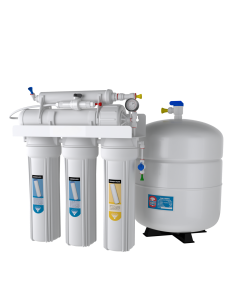
5-Stage Reverse Osmosis
Clean, great-tasting drinking water at your sink. Removes up to 99% of contaminants including lead, chlorine, fluoride, and more.
- 5-stage filtration
- Removes 99% of contaminants
- Under-sink design
- Dedicated faucet included
Browse all 12+ water treatment solutions
Recommended for Wilmington Homes
Systems that address Wilmington's specific water profile.
Filtration + Softening + RO
Complete Home System
Learn more →
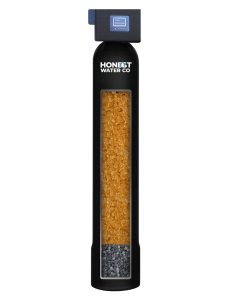
Single Tank Resin
Water Softener
Learn more →
7-Stage Tankless RO
HW800 AlkaPro RO
Learn more →
Under-Sink Drinking Water
5-Stage Reverse Osmosis
Learn more →
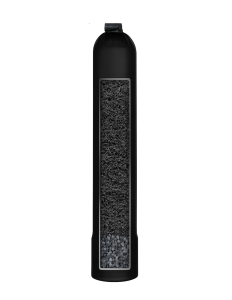
Chlorine & DBP Removal
Whole Home Carbon Filter
Learn more →
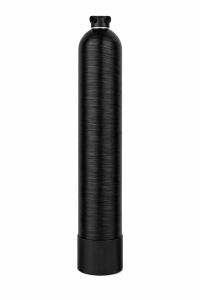
No Salt Required
Salt-Free Conditioner
Learn more →
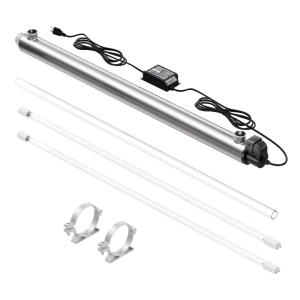
99.99% Germicidal Protection
UV Sterilizer
Learn more →
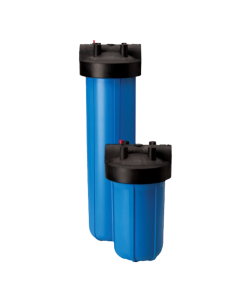
Whole House Protection
Pre-Sediment Filter
Learn more →
Wilmington Neighborhoods We Serve
Serving Wilmington and New Hanover County across the Cape Fear region.
Also Serving the Cape Fear Region
New Hanover, Pender and Brunswick counties.
One important caveat
The CFPUA figures on this page describe the CFPUA-Wilmington system only. Brunswick County towns like Leland, Belville, Navassa, Southport and Oak Island are served by different utilities with different source water and different treatment, and Pender County is different again. If you're outside CFPUA's footprint — or on a private well anywhere in the region — the only honest answer is to test your specific water before anyone specifies a system. We do that for free.
Water Quality in Wilmington, NC — Common Questions
Ready for Cleaner Water in Wilmington?
Free in-home water test, honest recommendation, lifetime warranty — no obligation.